A report by analysts of the National Renewable Energy Laboratory (NREL, by its acronym in English), entitled Estimating the Economic Potential of Renewable Energy in America: Methodology and initial results holds from a new method of analysis that Renewable generation is economically viable in many parts of the country due to the recent rapid decline in the costs of the technology used.
The new analysis method NREL researchers, under the Department of Energy, called geospatial, is used to estimate the economic potential of various renewable resources.
Allegedly at work, economic potential, a measure of the potential of renewable generation can be defined in several ways. "For example, a definition might expect revenues (based on local market prices) minus the costs of generation, considered over the expected useful life of the asset."
"Another definition could be generation costs relative to a reference point (for example, a combined-cycle natural gas), using assumptions of fuel prices, capital cost and efficiency of the plant" .
"The economic potential in this report is defined as the subset of technical potential of available resources when necessary cost of generating electricity (which determines the minimum income requirements for the development of the resource) below disposable income in terms displaced and displaced energy capacity. "
According to analyst NREL Philipp Beiter, and one of the authors of the study, "decreasing costs of renewable technologies it is an important driver for these results," adding: "the economic potential has more than tripled as a result of cost reductions already made by renewable generation technologies between 2010 and 2014, especially for wind and solar photovoltaic. "
The paper argues that the trend is likely to continue as more renewable energy deployment and continue reducing costs, expected for 2020 and 2030 that significantly increase their economic potential. By 2020 the economic potential equal nearly half of the annual demand for electricity in the United States, and 2030 will be 75% with the potential for profitable renewable energy generated in all the states.
23 November, 2015
03 November, 2015
World’s largest #CSP #Solar #Power Plant, by the Saharan #Sun 2 #Help #Renewables provide almost half the country’s energy by 2020
Now the trading city, nicknamed the “door of the desert”, is the centre for another blockbuster – a complex of four linked solar mega-plants that, alongside hydro and wind, will help provide nearly half of Morocco’s electricity from renewables by 2020 with, it is hoped, some spare to export to Europe. The project is a key plank in Morocco’s ambitions to use its untapped deserts to become a global solar superpower.
On the edge of the Sahara desert and the centre of the north African country’s “Ouallywood” film industry it has played host to big-budget location shots in Lawrence of Arabia, The Mummy, The Living Daylights and even Game of Thrones.
![]() |
| Ouarzazate solar plant will create enough electricity to power a million homes once it is finished.Photograph: Graeme Robertson for the Guardian |
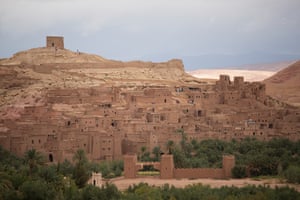
On the edge of the Sahara desert and the centre of the north African country’s “Ouallywood” film industry it has played host to big-budget location shots in Lawrence of Arabia, The Mummy, The Living Daylights and even Game of Thrones.
![]() |
The Ksar of Ait-Ben-Haddou, a group of earthen buildings surrounded by high walls, is the set of numerous movies. Photograph: Graeme Robertson for the Guardian |
When the full complex is complete, it will be the largest concentrated solar power (CSP) plant
in the world , and the first phase, called Noor 1, will go live next
month. The mirror technology it uses is less widespread and more
expensive than the photovoltaic panels that are now familiar on roofs
the world over, but it will have the advantage of being able to continue
producing power even after the sun goes down.The potential for solar power from the desert has been known for
decades. In the days after the Chernobyl nuclear accident in 1986 the
German particle physicist Gerhard Knies, calculated that the world’s
deserts receive enough energy in a few hours to provide for humanity’s power needs for a whole year. The challenge though, has been capturing that energy and transporting it to the population centres where it is required. The Ksar of Ait-Ben-Haddou, a group of earthen buildings surrounded by high walls, is the set of numerous movies. Photograph: Graeme Robertson for the Guardian As engineers put the finishing touches to Noor 1, its 500,000
crescent-shaped solar mirrors glitter across the desert skyline. The 800
rows follow the sun as it tracks across the heavens, whirring quietly every few minutes as their shadows slip further east. When they are finished, the four plants at Ouarzazate will occupy a space as big as Morocco’s capital city, Rabat, and generate 580MW of electricity, enough to power a million homes. Noor 1 itself has a generating capacity of 160MW. Morocco’s environment minister, Hakima el-Haite, believes that solar
energy could have the same impact on the region this century that oil
production had in the last. But the $9bn (£6bn) project to make her
country’s deserts boom was triggered by more immediate concerns, she
said. “We are not an oil producer. We import 94% of our energy as fossil
fuels from abroad and that has big consequences for our state budget,”
el-Haite told the Guardian. “We also used to subsidise fossil fuels
which have a heavy cost, so when we heard about the potential of solar
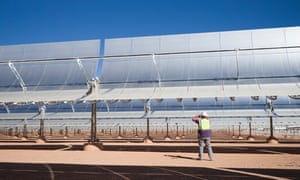
energy, we thought; why not?” Solar energy will make up a third of Morocco’s renewable energy supply by 2020, with wind and hydro taking the same share each. “We are very proud of this project,” el-Haite said. “I think it is the most important solar plant in the world.” Each parabolic mirror is 12 metres high and
focussed on a steel pipeline carrying a ‘heat transfer solution’ (HTF)
that is warmed to 393C as it snakes along the trough before coiling into
a heat engine. There, it is mixed with water to create steam that turns
energy-generating turbines. The HTF is made up of a synthetic thermal oil solution that is pumped towards a heat tank containing molten sands that can store heat energy for three hours, allowing the plant to power homes into the night. The mirrors are spaced in tier formations, to minimise damage from sand blown up by desert winds.
Technicians say that the Noor 2 and 3 plants, due to open in 2017
will store energy for up to eight hours – opening the prospect of 24/7
solar energy in the Sahara, and the surrounding region. “The biggest challenge we faced was being able to finish the project
on time with the performance [level] we needed to achieve,” said Rashid
al-Bayad, the project director. But even as the first phase of the project nears completion, Morocco
is eyeing grander international ambitions. “We are already involved in
high tension transportation lines to cover the full south of Morocco
and Mauritania as a first step,” says Ahmed Baroudi, manager of Société
d’Investissements Energétiques, the national renewable energy
investment firm. But he says the project’s ultimate impact will go far
wider – even as far as the Middle East. “The [ultimate] objective given
by his majesty the king is Mecca.” Whether that ambition is achieved remains to be seen but exporting
solar energy could have stabilising effects within and between
countries, according to the Moroccan solar energy agency (Masen). Talks
are ongoing with Tunisia, and energy exports northwards across the
Mediterranean remain a key goal, despite the collapse in 2013 of the Desertec project, a German plan to source 15% of Europe’s energy from North African desert solar by 2050. Renewable energy and the politics of subsidies Letters: How are we ever to wean ourselves off fossil fuels when government policy is so skewed in their favour? Read more “We believe that it’s possible to export energy to Europe but first
we would have to build the interconnectors which don’t yet exist,” said
Maha el-Kadiri, a Masen spokeswoman. “Specifically, we would have to
build interconnections, which would not go through the existing one in
Spain, and then start exporting.” Spain has itself prohibited new solar projects because of a lack of
interconnectors to transmit the energy to France. The EU has set a target of ensuring that 10% of each member country’s power can be transported abroad by cable by 2020. In the meantime, Morocco is focused on using solar to meet its own
needs for resource independence. This could one day include water
desalination, in a country that is increasingly being
hit by drought as the climate warms. Officials are keenly aware of the
running they are making in what is the most advanced renewable energy
programme in the Middle East and North African region. “We are at the avante-garde of solar,” el-Kadiri says. About $9bn has been invested in the Noor complex, much of it from
international institutions such as the European Investment Bank and
World Bank and backed by Moroccan government guarantees. Undisclosed
energy subsidies from Morocco’s unelected ruler, King Mohammed VI, have
prevented the cost from being transferred to energy consumers. 60 second climate fix: Can the sun cool down the Earth? One month before launch, over a thousand mostly Moroccan workers are
still racing to fix electric wires, take down scaffolding and wrap
rockwool insulation around steel pipelines. They bustle past in yellow
and orange bibs, working 12-hour shifts against a backdrop of the Atlas
mountains. Harnesses with hammers and gloves strapped to their belts
swing by their sides. Ubiquitous hard hats, safety shoes and ear plugs
give the scene an air of theatrical camp. For Hajar Lakhael, a 25-year-old environment and security manager
from Meknes, rehearsals are almost over and the blockbuster production
is nearly ready for action. “We’ve done the construction and now we will see how these projects
look when they start,” she says. “It is exactly like the preparation for
a grand performance.” A global audience will be watching with interest. Source: The Guardian
![]() |
| The 12 metre-high parabolic mirrors. Photograph: Graeme Robertson for the Guardian |
27 October, 2015
Vote so that Cervantes will have his Star... www.estrellacervantes.es
www.estrellacervantes.es muArae b and Dulcinea, Quijote, Sancho & Rocinante are the candidates to become muArae c, muArae d, and muArae e into its four respectively planets #YoEstrellaCervantes
An informative Cervantes Star Video Project developed by Francisco Javier Gorgas, astrophysicist at UCM and president of the Spanish Society of Astronomy. www.estrellacervantes.es #yoEstrellaCervantes.
Star name / planet name Proposed names
mu Arae Cervantes from Miguel de Cervantes Saavedra, Spanish novelist, poet and playwright (1547-1616). Author of "Don Quixote". Somewhere in the Ara constellation, around a star without a proper name, only known by the letter "mu", four planets trace their paths. Around an author of universal fame, also his four main characters revolve. We propose to elevate Cervantes to the status of a galactic Apolo, lending his name to the system's central star, while Don Quijote (Quixote), Rocinante, Sancho and Dulcinea are justly transfigured into his planetary escort. Quijote (muArae-b), the leading character, in a somewhat eccentric orbit, befitting to his character, and beside his faithful companion Rocinante (muArae-d) in the middle of the scene. Good Sancho (muArae-e), the ingenious squire, moving slowly through the outer 'insulae' of the system. The enchanted Dulcinea (muArae-c), so difficult for Quijote to contemplate in her real shape, close to the heart of the writer.
The importance of Miguel de Cervantes in the universal culture can hardly be overestimated. His major work, Don Quijote, considered the first modern novel of world literature and one of the most influential book in the entire literary canon, has many times been regarded as the best work of fiction ever written. However, while Shakespeare has his Uranian satellites, Cervantes has been so far excluded from the cosmic spheres. With this proposal, supported by the prestigious Cerantes Institute, and arriving just in time for the 400 Anniversary of the publication of the novel's second part, we reclaim for the Famous Knight of la Mancha, his comrades and their creator the place that they deserve among the stars.
mu Arae b http://nameexoworlds.iau.org/systems/106#planet-15 Quijote
From "The Ingenious Gentleman Don Quijote (Quixote) of La Mancha", the protagonist of the novel written by Cervantes. His reading in excess of books of chivalry waved his mental faculties, believing the fictions of the books as real facts...
mu Arae c http://nameexoworlds.iau.org/systems/106#planet-16 Dulcinea
Dulcinea del Toboso, fictional character in the novel 'Don Quijote' written by Cervantes, is a peasant converted in the fantasies of Quijote as the most beautiful of the women, object of his true love and devotion.
mu Arae d http://nameexoworlds.iau.org/systems/106#planet-17 Rocinante
Rocinante is Don Quijote's horse in the novel by Cervantes. As a member of the chivalry, Quijote believes this work horse is the most valuable horse a knight can ride.
mu Arae e http://nameexoworlds.iau.org/systems/106#planet-18 Sancho
Sancho Panza is a fictional character in the novel 'Don Quijote' written by Cervantes. He acts as a squire to Don Quijote, a peasant man of broad humor and irony, and always bound to Earth.
Somewhere in the Ara constellation, around a star without a proper name, only known by the letter "mu", four planets trace their paths. Around an author of universal fame, also his four main characters revolve. We propose to elevate Cervantes to the status of a galactic Apolo, lending his name to the system's central star, while Don Quijote (Quixote), Rocinante, Sancho and Dulcinea are justly transfigured into his planetary escort. Quijote (muArae-b), the leading character, in a somewhat eccentric orbit, befitting to his character, and beside his faithful companion Rocinante (muArae-d) in the middle of the scene. Good Sancho (muArae-e), the ingenious squire, moving slowly through the outer 'insulae' of the system. The enchanted Dulcinea (muArae-c), so difficult for Quijote to contemplate in her real shape, close to the heart of the writer.
The importance of Miguel de Cervantes in the universal culture can hardly be overestimated. His major work, Don Quijote, considered the first modern novel of world literature and one of the most influential book in the entire literary canon, has many times been regarded as the best work of fiction ever written. However, while Shakespeare has his Uranian satellites, Cervantes has been so far excluded from the cosmic spheres. With this proposal, supported by the prestigious Instituto Cervantes, and arriving just in time for the 400 Anniversary of the publication of the novel's second part, we reclaim for the Famous Knight of la Mancha, his comrades and their creator the place that they deserve among the stars.
Subscribe to:
Posts (Atom)